

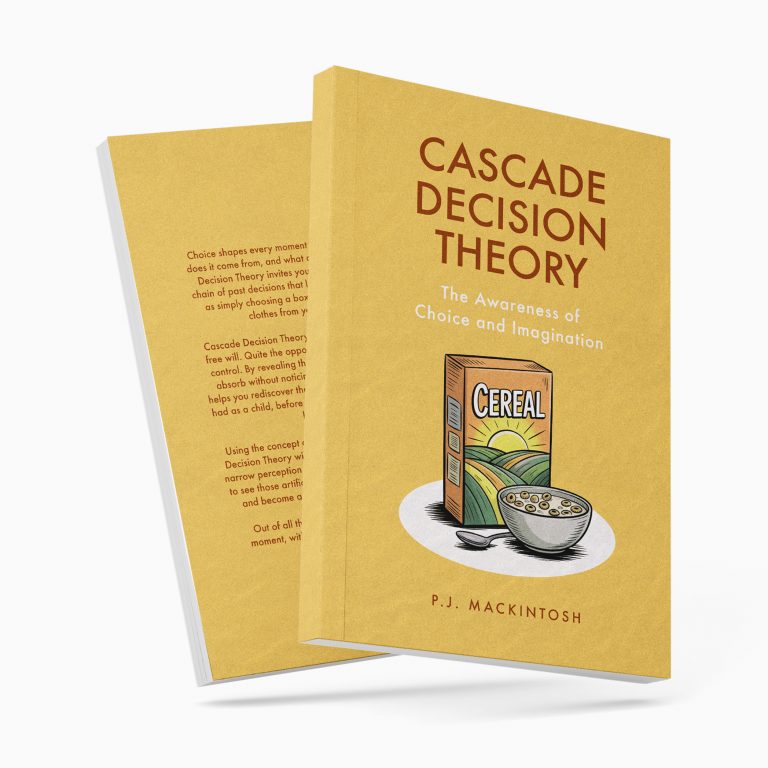
Choice shapes every moment of our lives, but where does it come from, and what quietly limits it? Cascade Decision Theory invites you to explore the hidden chain of past decisions that lead to every action, such as simply choosing a box of cereal or putting on clothes from your wardrobe.
Cascade Decision Theory is not an argument against free will. Quite the opposite. It is an invitation to take control. By revealing the norms and assumptions we absorb without noticing, Cascade Decision Theory helps you rediscover the imaginative freedom you once had as a child, before the world taught you its artificial boundaries.
Using the concept of Signal‑to‑Noise Ratio, Cascade Decision Theory will demonstrate how rigid ideas can narrow perception and block the new. When you learn to see those artificial limits, you can step beyond them and become a visionary five-year-old once more.
Out of all the possibilities, you are here, in this moment, with a choice. Will you explore further?
For us, when we are born, we perceive our space as an analogue continuum, stretching from the very small to the very large. We are taught to divide it into digestible chunks. An overlay of discrete concepts, a digitisation of space and time, often dictated by the limits of our language.
- The question is, whose chunks are we digesting?
- Who made historic choices that we continue to live with today?
Cascade Decision Theory allows us to question what is accepted and taken for granted. Once you know where the limits are, you can look over the artificial boundary and become a visionary.
It invites a deeper look at how we arrived here, at this point in time and space, for you to read this post. Your life events have brought you here, and that should be celebrated.
What, then, is at the end of the cascade? Where is all of this leading us? Who knows?
In 1968, George Land and Beth Jarman, carried out the paperclip experiment. They asked a group of 5-year-olds how many uses they could come up with for a paperclip. They repeated the test when the children were ages 10 and 15. And then tested a group of adults. The proportion of people who scored at the genius level:
- 98% 5-year-olds
- 30% 10-year-olds,
- 12% 15-year-olds
- 2% Adults
The possible reason, the children had a ‘free’, unrestricted imagination, which became constrained with age, conformity and language.
Try to free your imagination as much as possible and release your childhood imagination; that’s where true choice lies and the ability to become a visionary.
We were all children once; we have it in us. Trust me, you can do it!
Enter your limitless imaginative void and let it soar!